01 / FIELD SYSTEM
UT-OR/26
HIGH-RESOLUTION MULTI-PRESSURE CIMS
ORBION
Reveal more chemistry in a single measurement.

Orbion is an integrated high-resolution multi-pressure chemical ionization mass spectrometer (HR-MPCIMS) for real-time, non-targeted molecular profiling of air, gas mixtures, aerosols and headspace.
120,000–240,000
RESOLVING POWER
High-resolution separation of molecular signals in chemically dense spectra. Isotopic compound matching.
SOLID-STATE
REAGENT GENERATION
Selected reagent ions are generated from solids using X-ray desorption. Safe, no-maintenance.
SECONDS-SCALE
REAGENT + POLARITY SWITCHING
Change ionization chemistry and polarity within a measurement sequence.
VOCs → HOMs
CHEMICAL COVERAGE
From less-polar volatile organics to reduced nitrogen, oxidized and highly oxygenated organics.
SYSTEM NOTE /
Solid-state reagent generation is available for selected ion chemistries and configurations. Detection limits and sensitivity depend on reagent chemistry, target compound, sample matrix and acquisition settings.
02 / PERFORMANCE
THE MOST POWERFUL CIMS COMMERCIALLY AVAILABLE
High resolution, ultra sensitivity and broad chemical reach.
MEASUREMENT EXAMPLES / ORANGE PEELING + SULFURIC ACID CALIBRATION — real Orbion data, processed end-to-end through Mascope and Peaky.
RESOLUTION
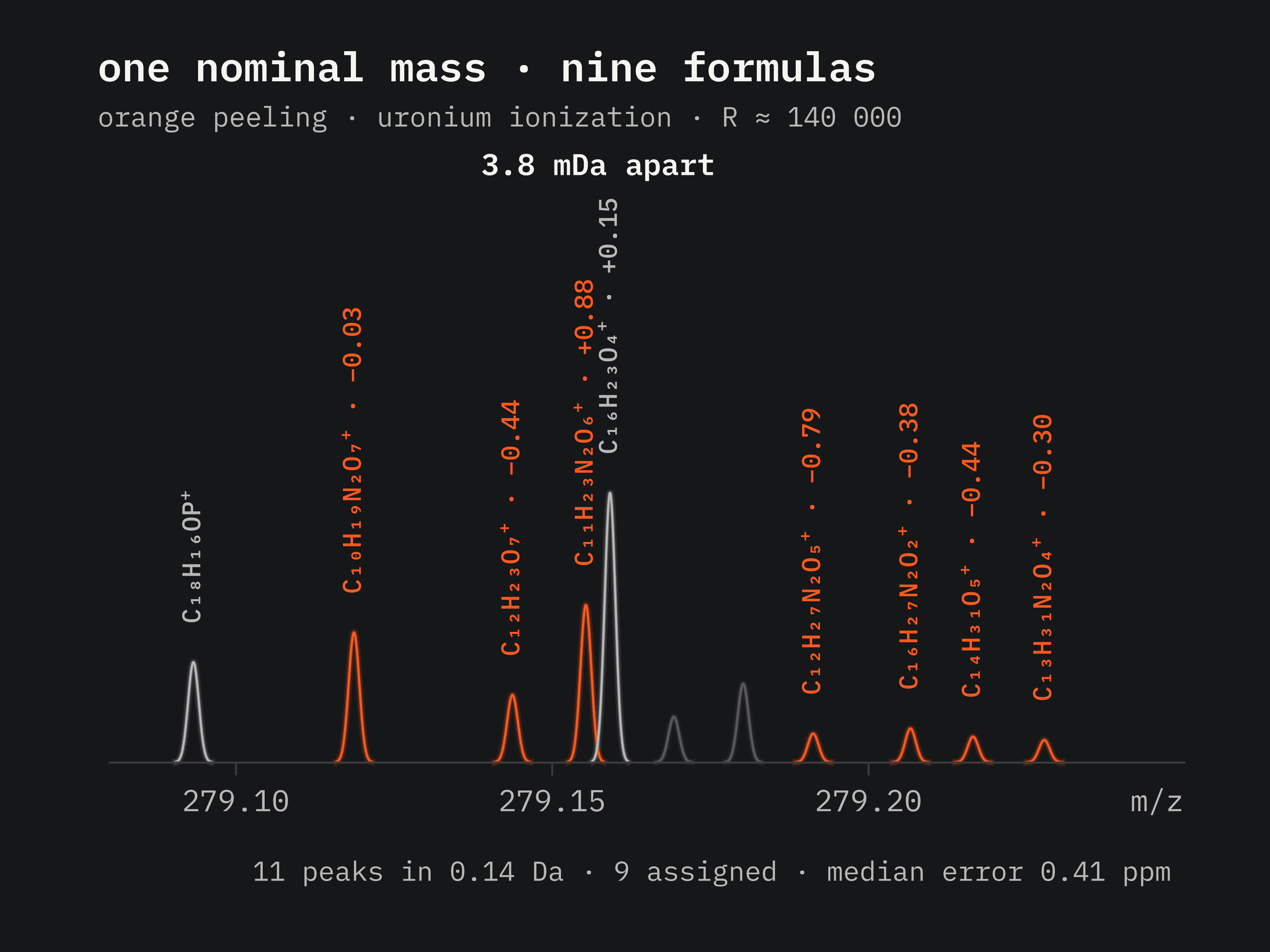
One nominal mass, nine formulas. Eleven peaks within 0.14 Da at m/z 279; a monoterpene oxidation product sits 3.8 mDa from a common plasticizer — separated and assigned with sub-ppm mass accuracy.
SENSITIVITY

One 30 ppt calibration read down to 5 ppq equivalent. Twelve held stages of a sulfuric acid calibration; natural heavy-isotopologue abundances act as built-in dilutions tracing a single linear response.
CHEMICAL REACH

1,691 molecular formulas from one experiment. Complementary uronium and bromide chemistries cover reduced primary emissions through highly oxygenated products, C2 to C30.
No other commercial CIMS combines this: resolving power of 120,000–240,000 — an order of magnitude above typical TOF-CIMS — detection demonstrated to 5 ppq and attomole-level sensitivity to amines (Anal. Chem. 2025, 97, 21282), and coverage from hydrocarbons to highly functionalized molecules in a single measurement via multi-pressure chemical ionization (Anal. Chem. 2024, 96, 19926).
Achievable performance remains dependent on the compound and measurement configuration.
03 / IONIZATION SYSTEM
THE PRESSURE CHANGES THE CHEMISTRY
Chemical ionization is selective by design. Different compounds respond to different reagent ions and reaction conditions.
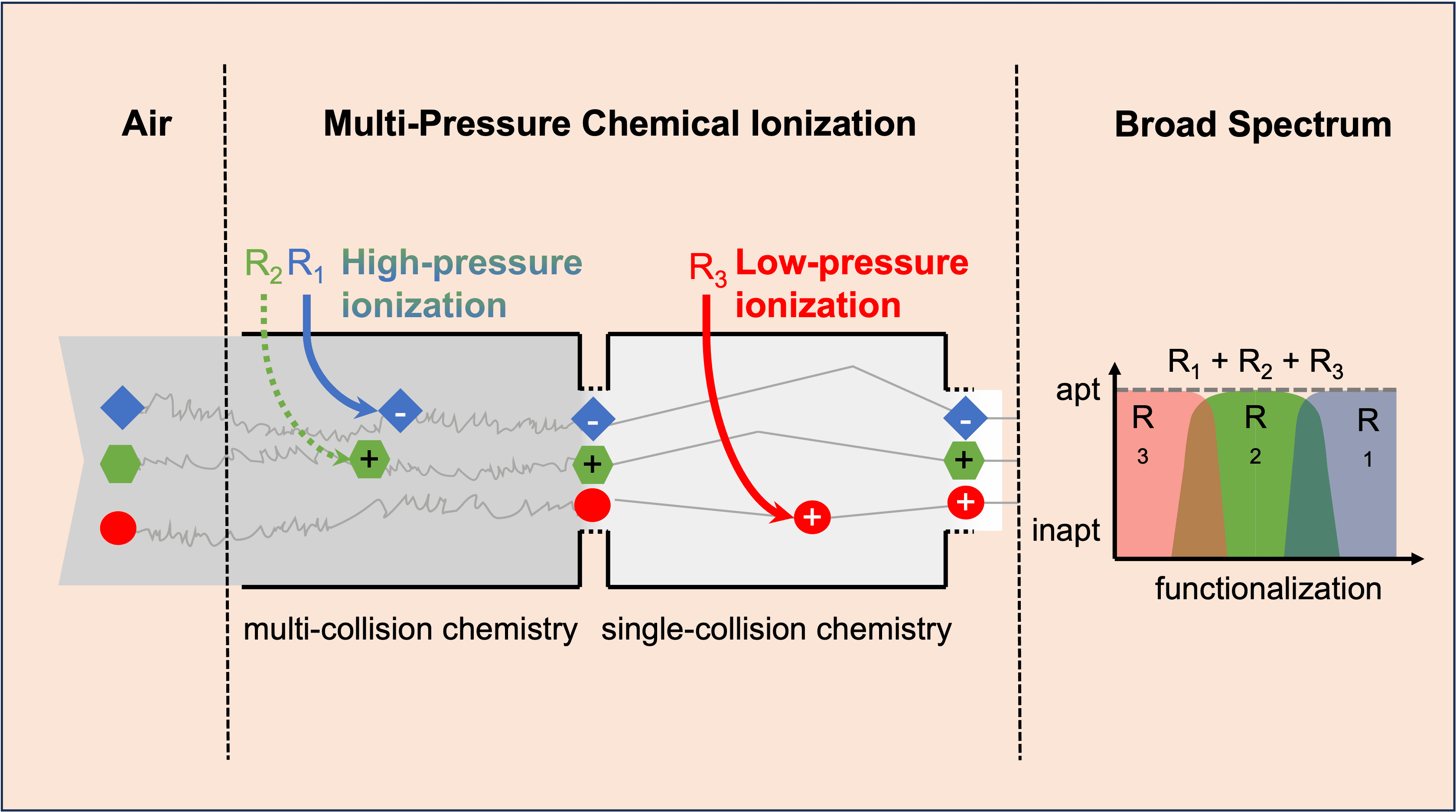
MULTI-PRESSURE IONIZATION / SCHEMATIC
High-pressure ionization is well suited to oxygenated and multifunctional molecules that form stable interactions with reagent ions. Positive-ion uronium chemistry adds a distinct capability for amines and other high-proton-affinity compounds. Low-pressure ionization extends detection toward less-polar volatile organic compounds that interact too weakly under ambient-pressure conditions.
Orbion combines these complementary chemical views through multi-pressure chemical ionization (MPCI) within one coordinated platform.
HIGH-PRESSURE CI
Functionalized compounds
Selective ion-molecule chemistry for polar, oxygenated and multifunctional compounds.
URONIUM CI
Amines & alkaline species
Positive-ion chemistry for amines, ammonia and other high-proton-affinity compounds, with strong relevance for difficult basic and semivolatile analytes.
LOW-PRESSURE CI
Less-polar compounds
Extends detection toward weakly interacting volatile organic compounds and less-oxygenated precursors.
RAPID SWITCHING
Multiple chemical views
Change reagent ion and polarity in seconds to examine complementary molecular populations within the same measurement workflow.
DISTINCTIVE CAPABILITY / URONIUM
Positive-ion access to basic and high-proton-affinity compounds.
Uronium chemistry provides Orbion with a particularly strong route to amines and other compounds that are difficult to capture via the negative-ion chemistries commonly used for oxygenated atmospheric molecules. This expands the usable chemical space toward basic, semivolatile, and solvent-like species.
Examples include amines, ammonia, dimethyl sulfoxide, N-methyl-2-pyrrolidone and dimethylformamide.
04 / REAGENT CHEMISTRY
CHOOSE THE CHEMISTRY FOR THE QUESTION
Different reagent ions reveal different molecular populations.
Orbion can use complementary positive- and negative-ion chemistries. The appropriate reagent depends on the target compounds, required selectivity, sample composition and operating environment.
RI-01 NITRATE / NO₃⁻ — Selective detection of acids, highly oxygenated organic molecules and organonitrates.
RI-02 BROMIDE / Br⁻ — Detection of oxygenated organic molecules, small acids, selected iodine-containing compounds and HO₂ radicals.
RI-03 URONIUM / CH₅N₂O⁺ — Sensitive detection of amines, ammonia, dimethyl sulfoxide, N-methyl-2-pyrrolidone, dimethylformamide and selected semivolatile compounds.
RI-04 LOW-PRESSURE / C₁₆H₁₀⁺ — Electron-abstraction chemistry for less-polar volatile organic compounds and less-oxygenated precursors.
05 / SAMPLING
REAL-TIME + INTEGRATED
ONE PLATFORM. MULTIPLE SAMPLE PATHS.
Direct gases, integrated samples and particles.

SAMPLING / ONLINE DESORBER

SAMPLING / AMBIENT MEASUREMENT INLET
Orbion’s modular sampling architecture supports both continuous and integrated measurements in laboratory and field deployments.
The system can extend molecular access from volatile gas-phase compounds toward semivolatile and particle-associated species without separating the measurement into unrelated instrument platforms.
SP-01 DIRECT GAS + HEADSPACE — Real-time molecular profiling of ambient air, chamber air, gas mixtures, process streams and headspace samples.
SP-02 FILTER DESORPTION — Controlled analysis of compounds collected during integrated filter-sampling workflows.
SP-03 ONLINE PARTICLE DESORPTION — Extend molecular analysis toward particle-associated and semivolatile material.
06 / SYSTEM WORKFLOW
SAMPLE → DATA
FROM AIR TO MOLECULAR INFORMATION
A connected path to knowledge.
Orbion integrates sample introduction, reagent-ion selection, multi-pressure chemical ionization, high-resolution mass analysis and connected data handling into one measurement workflow.
01 SAMPLE → 02 SAMPLE INTERFACE → 03 REAGENT IONS → 04 HIGH- OR LOW-PRESSURE CI → 05 HIGH-RESOLUTION MASS ANALYSIS → 06 MASCOPE
Turn Orbion measurements into structured, accessible molecular data.
Mascope handles ingestion, storage, signal processing, browser-based exploration and programmatic data access.
07 / SCIENTIFIC BASIS
SELECTED PUBLICATIONS
Methods demonstrated in peer-reviewed research.
2024 — From Hydrocarbons to Highly Functionalized Molecules in a Single Measurement: Comprehensive Analysis of Complex Gas Mixtures by Multi-Pressure Chemical Ionization Mass Spectrometry
Analytical Chemistry, 96, 19926–19932
2025 — Uronium from X-ray-Desorbed Solid Urea Enables Attomole Sensitivity to Amines and Semivolatiles
Analytical Chemistry, 97, 21282–21290
08 / TECHNICAL SUMMARY
ORBION PLATFORM
Technical summary
INSTRUMENT CLASS — High-resolution multi-pressure chemical ionization mass spectrometer
MASS ANALYSIS — High-resolution Orbitrap mass analysis
IONIZATION REGIMES — Complementary high- and low-pressure chemical ionization
SWITCHING — Rapid reagent-ion and polarity switching in seconds
RESOLVING POWER — 120,000–240,000 available resolving-power settings
DETECTION PERFORMANCE — Sub-ppt detection demonstrated for selected compounds and configurations; performance is application-specific
REAGENT EXAMPLES — Nitrate, bromide, uronium, low-pressure fluoranthene, iodide and ammonium chemistries
CHEMICAL ACCESS — Volatile, polar, oxygenated, highly oxygenated and multifunctional compounds, depending on the selected chemistry
SAMPLING — Direct gas and headspace, filter desorption and online particle-desorption configurations
DEPLOYMENT — Laboratory experiments and field measurement campaigns
DATA WORKFLOW — Connected processing and analysis through Mascope
CONFIGURATION — Application-specific selection of ion chemistry, sampling interface and acquisition method
09 / CONTACT
DISCUSS YOUR MEASUREMENT CHALLENGE.
Tell us what you need to detect, where you need to measure it and what currently remains invisible.
CONTACT US →